
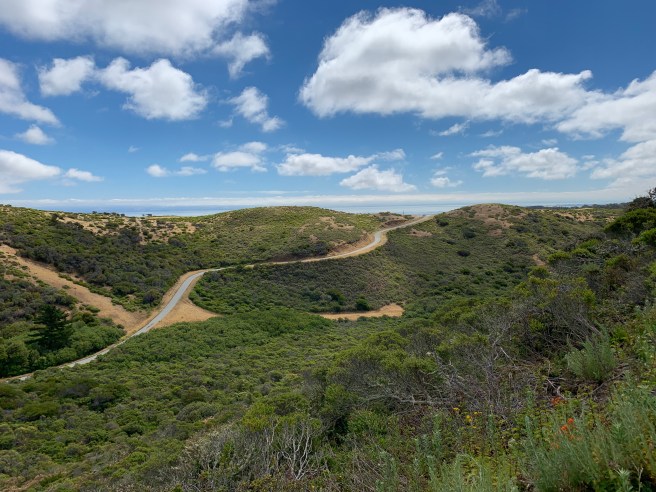
The Sweeney Ridge Trail starts at the end of Sneath Lane, in San Bruno, California, about 15 miles south of San Francisco. Due south are San Andreas (yes, same as the fault) Lake and Crystal Springs Reservoir, which is fed by Hetch Hetchy Reservoir, in Yosemite, more than 180 miles to the east. It is as gorgeous and vibrant an area as any, except perhaps on hot, hazy days, with moderate (or worse) air quality. At the top of the trail, at the Portola Discovery Site, on a clear day you can enjoy a 360 degree view of Montara Mountain, to the south, Mount Diablo, to the east, Mount Tam, to the north, and the mighty Pacific, to the west. As intimated above, my most recent Sweeney Ridge Trail hike was not one which afforded those crystal clear, postcard views. Air quality, while technically moderate, seemed poor, gritty, metallic. It was unusually hot, especially given our proximity to the coast, with little wind. Relentless flies descended on the trail. Two hours of near incessant (but quite justifiable) complaining and nagging, from some members of our intrepid hiking crew. My dog, Roxy, could not decide if she wanted to walk with my spouse or me; she preferred my (faster) pace, but did not want to leave my spouse’s side. The distance was short (5 miles), but everyone (especially the other dog in our expedition) felt sluggish, feet stuck in mud (perhaps a metaphor for the past 18+ months). The end could not come soon enough. Simply put, same trail, very different hike.
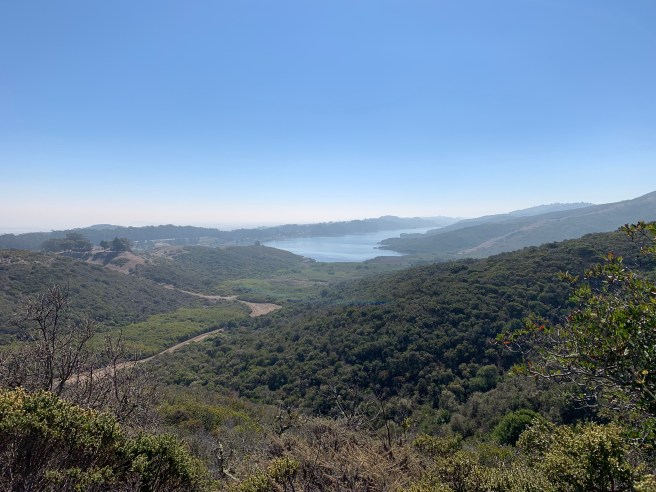
What to do? Stay home, until conditions improve? Pick a better, dog-friendly trail? Notably, and surprisingly, the best trails in the mid-Peninsula do not allow dogs. Try to find a silver lining in this otherwise somewhat miserable outdoor experience? On one level, a hike is a hike, and I should be more thankful. I am glad to be outdoors, away from the screen, whenever possible. Invariably, there will be breaks in the complaining, especially on the downhill portions. At the same time, even during a pandemic, part of me expects (perhaps unreasonably) a better experience, more progress, less feet stuck in mud.
The last observation, below, may be a stretch, but bear with me. Oversimplifying, there are two components to a good hike: topography and conditions. Great topography (elevation change, variety (narrow paths, fire roads, etc.), tree cover, vistas, etc.), but poor conditions (see above), make for a bad hike. Same goes for the inverse: a beautiful, clear, cool sunny day, on a flat, boring trail. Extrapolating (a bit), just as both topography and conditions matter, so do substance and presentation, when creating and delivering a superior work product, running an effective meeting, etc. So, with this in mind, here are a few rules of thumb:
- Simplify where possible. Outline, organize, write, and re-write.
- Presentation is just as important as substance. Be intentional on the mode(s) and how the information is actually conveyed on a slide, memo, technical paper, etc. For some meetings, a one pager might be ideal. For others, a combination of a short slide deck (see below), with an accompanying memo, not to exceed ten (10) pages, might be ideal. The best way to test an idea is to write a short paper on it. Typically, experience is usually the best teacher as to what works best, given the circumstances. That said, please consult with others on your team, etc. on this very important topic.
- Identify and focus on your top (3-5) points. Do the hard analysis. Aim for no more than ten (10) slides in a presentation, not including backup.
- Who’s your audience?
- What’s your CTA (call to action)? What do you want your audience to do (or not do)? Start with your objective and work backwards. Is the purpose to inform, discuss, reach a decision, etc. State the purpose up front, to orient the audience, and from time to time, remind the audience of the purpose.
- Practice, practice, practice (and then practice some more). Timing and pacing are critical.
- Include pictures if they help illustrate your points and advance your narrative.
- Stories (good ones) are more impactful then virtually anything else. A week later your audience may not remember the finer points of your presentation, but attendees will remember a good story.
- Answer questions to the best of your ability, but if you do not have the answer, say so, and be sure to follow up after the meeting. This goes to your credibility.
- Be sure to leave a few minutes to discuss and assign responsibilities for next steps.
Comments welcomed.


