

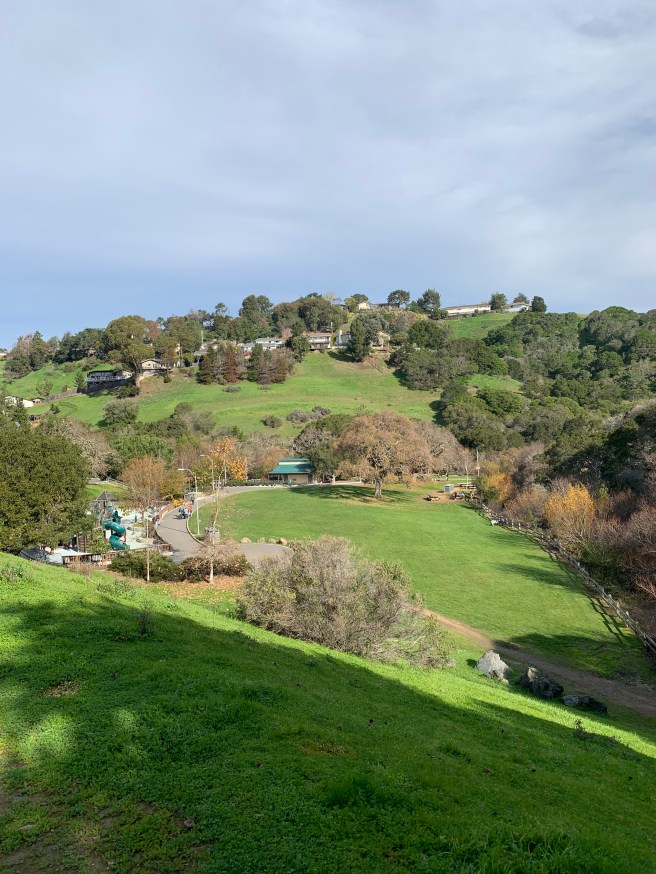
The surge continues. But, at Sugarloaf Peak, in San Mateo, but for a masked hiker (new show?) or two, it might as well be business as usual. Mind you, Sugarloaf was not my first choice. Pulgas Ridge (https://johnpavolotsky.com/2021/12/24/pulgas-ridge-and-hiking-year-in-review/), my go-to for dog friendly hikes, was packed, no parking except on the streets, perhaps a third of a mile or more from the entrance, and so it was Sugarloaf, much smaller, but also closer to my house, isolated enough in spots to get away from it all, from news of travelers being stranded from Dubai to Chile due to positive COVID tests, soaring local positivity rates, daily close contact letters, schools going remote, a state of emergency in Alpine County, just south of Lake Tahoe (https://johnpavolotsky.com/2022/01/03/lake-tahoe/), lots of streaming (thank you, broadband Internet), and in some respects back to the future (or at least 2020). No tsunami in sight from my 500-foot vantage point, just a hawk or two, green hills, coastal oaks, no wind, relatively warm (60 degree F) January air, clear sky with a few high clouds.
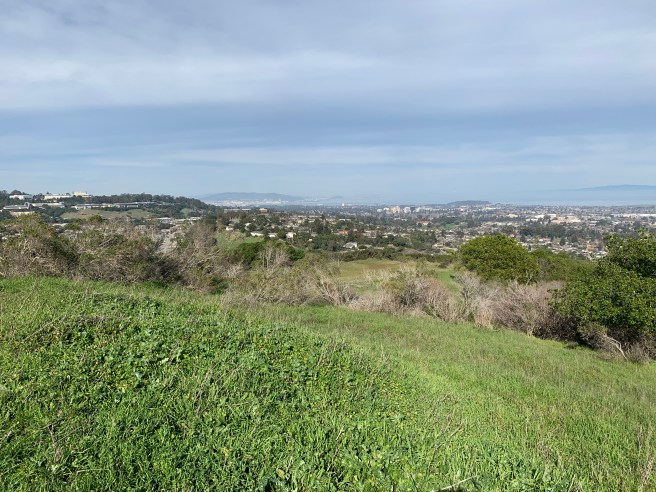
As intimated above, Sugarloaf was not part of the plan when I woke up. It did, however, meet my criteria for a hike that day: fewer than 10 miles from my house, dog-friendly (remarkably there are few options nearby), not super-crowded, reasonable parking options, intermediate difficulty, 2-5 miles.
Similarly, my longer monthly hikes have their own criteria: at least 3000 feet vertical rise, 8-12 miles, 4-6 hours, high level of difficulty, not more than an hour from my house. To be sure, there are exceptions, like November’s hike to Point Reyes (https://johnpavolotsky.com/2021/11/22/point-reyes/), but the exceptions are just that. Put otherwise, the design is intentional.
I published my first annual top ten ideas list (https://johnpavolotsky.com/2022/01/05/top-10-ideas-2022/) shortly after the first of the year. Idea #9 was:
9. Organization is king, queen, etc. Focus on organizational design on the front end to avoid issues on the back end. No structure is perfect, but no structure is worse than a less than perfect one, that can be adjusted later. Plan for resiliency and be ready to adapt. Okay, there are a few important ideas here, but they are related, and I only have space for ten.
I have been asked to expand on organizational design and its criticality to the success of a group or a company. Expert on org design I am not. That said, I have experienced good and not-so-good design over the years, planned and/or implemented org structures that worked well (and others not so much), and last, but not least, studied org behavior and design in a past life (namely, business school). A lot of this is common sense. Be thoughtful and intentional at all levels, whether designing the req for an opening in a group, the structure of the group itself, a department, or the broader organization. Publish the design principles. Discuss and debate them, to a point. Ultimately, an unimplemented design is as good as no design at all. Implement the design in accordance with the design principles. Among other things, this builds and enhances trust. Conversely, creating design principles and then, for a job req as an example, selecting someone who does not seem to meet them and/or not following the published vetting process (i.e., pre-selecting someone without regard to the design principles or process) will erode trust. Put simply, design principles cannot be window pressing. Last, but not least, design principles are not set in stone. If after some time (e.g., 3-6 months), it is clear that some changes are in order, revisit, adjust, and re-implement. Sure, constant change will at best create whiplash, so careful diagnosis will be required to pinpoint the issue(s) and help identify the possible structural solution(s). In the end, a sturdy, but flexible, structure, with clear expectations, will help engender trust, increase stability, and improve velocity.
Good luck and comments welcomed.

 The Peninsula Hiking Club