

Innovation is everywhere. During an October 2019 visit to Pisa, one of the great university cities of Europe, if not the world, I saw a poster (pictured above) for an international exhibition titled: “OLIVETTI @ TOSCANA.IT, Territorio, comunità, architettura nella Toscana di Olivetti. Recall, perhaps, Adriano Olivetti, the Italian industrialist, of typewriter, calculator, and personal computer fame. Unfortunately, I did not have enough time to see the exhibition, having visited the Piazza dei Miracoli earlier in the day and pressed to catch the train for Viareggio, before heading back to our home base in Lucca.
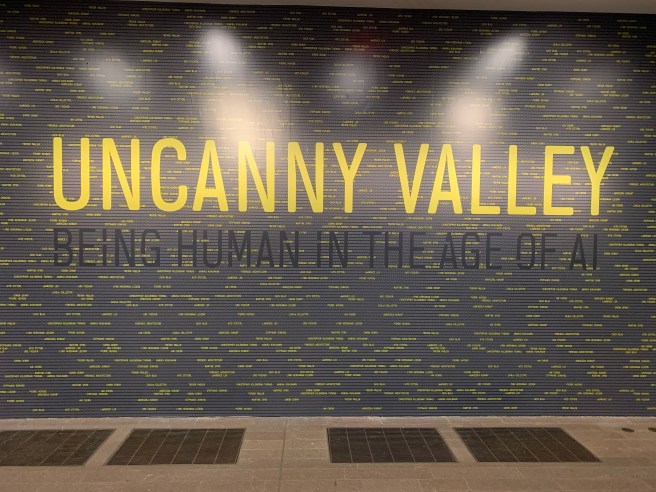
Closer to home, I visited the De Young Museum (San Francisco) in November 2020, avec masque bien sur, to experience the Uncanny Valley – Being Human in the Age of AI – exhibit (pictured below). Shortly thereafter, museums, and other indoor venues, closed (again).
Innovation is easier done than said. Most quotes or, more broadly, prescriptions fall flat, although there a few exceptions. One of my favorites is from Robert Noyce: “Innovation is everything. When you’re on the forefront, you can see what the next innovation needs to be. When you’re behind, you have to spend your energy catching up.” Pre-pandemic, I would see this quote at least once a day, in the lobby of Intel RNB (Robert Noyce Building), where I have worked for the past eight years. The Intel Trinity (Malone) is a worthwhile read.
In preparing for a talk to international students in the Berkeley Haas Global Access Program las week, I included a few additional quotes to help frame the discussion.
Steve Jobs: “Innovation distinguishes a leader from a follower.”
Jeff Bezos: “If you’re competitor-focused, you have to wait until there is a competitor doing something. Being customer-focused allows you to be more pioneering.”
Steve Jobs (Isaacson) and The Everything Store: Jeff Bezos and the Age of Amazon (Stone) are, likewise, recommended.
Innovation is a hot topic, especially in Silicon Valley, where I have worked for the past twenty years. In the late 2000s, I worked in the CRM (customer relationship management) software space. Recall, perhaps, that around that time (2009, to be precise), Marc Benioff published Behind the Cloud: thesaleforce.com playbook. Below is one of my favorite quotes on innovation, probably more hyperbole than anything, but with at least an ounce of truth, I am sure: “I came up with the idea about how to build salesforce.com in my sleep. Literally. I had a weird dream in which I envisioned Amazon.com, but instead of tabs with Books, CDs, or DVDs, they said Accounts, Contacts, Opportunities, Forecasts, and Reports.”
I had the pleasure, at around that time, of meeting at an annual software developer conference the inimitable Paul Greenberg, author of CRM at the Speed of Light, the bible of CRM. On innovation, Greenberg mentions IBM’s Innovation Jams, regularly cadenced and structured virtual innovation meetings, to brainstorm new products and enhance existing ones.
I started my talk on innovation by exploring data marketplaces, with specific reference to the Snowflake Data Marketplace and the AWS Data Exchange. I had written on the subject in the Winter 2020 issue of New Matter (IP Section, California Lawyer Association), hypothesizing:
If the past is any indication of the future, the current fragmented data landscape (putting to the side platform companies that have amassed their own data troves and would probably not be interested in sharing these competitive assets) will become more concentrated, and a few data marketplaces may be the ultimate winners. To be relevant, a data provider might feel compelled to distribute its data through on these exchanges. Similarly, larger, more powerful data providers may, individually or as a consortium, create their own exchanges. Recall, perhaps, that the Sabre Global Distribution System was developed in part by American Airlines and, in time, inventory from other carriers was made available through it. At any rate, only time will tell if and when the current data marketplaces will take off (pardon the pun).
Innovation is, among other things, subject to many complex variables and forces. Whether an innovative offering will “succeed” in the market is usually only determined after the fact.
During my talk, I covered several sub-topics. Below are a few “insights.”
- Approach to innovation? Innovation means “to begin or to introduce (something new); to be creative.” Usually dictionary (here, American Heritage Dictionary) definitions are not terribly useful, but this one serves some purpose. Typically, and especially, in Silicon Valley, we think of technology innovation, but the term is considerably broader than that. Innovation can cover a product, service, process, or delivery model. A new course can be innovative, as can a book or an article. Imagine an empty green field (and no map or playbook). Or, imagine a crowded field (and a map and playbook, but ones that are not terribly helpful in solving the problem at hand). Scary, yes, but an opportunity as well. This, then, brings me to the crux (at least in my mind) of innovation: problem solving. Note that your current toolbox may work quite well even for new and seemingly intractable problems, but there is a good chance that it will not. The set of potential solutions will require a broader aperture and some “out-of-the-box” thinking. Any number of factors can drive or support innovation, including an internal roadmap, customer requirements, market or business trends, opportunities and/or inefficiencies. Innovation can occur through structured discovery (Innovation Jams) or serendipity (Benioff’s dream).
- How to bring innovation into your team’s work? Perspective (internal and external) helps, as do curiosity and a keen desire to solve problems. Time and space to innovate (and different success metrics from your mainline businesses (see The Attacker’s Advantage (Charan)) are also helpful.
- How to incorporate data/strategy/culture into your work/team? This is a critical, and loaded, question. Innovation requires a roadmap and metrics. Beyond the initial idea or hunch, it requires leadership (clear direction, accountability, etc.), resources (money, technical (engineering, etc.) staff, time), project management, talent, an optimistic, collaborative, but critical (in terms of the problems to be solved) culture, and support from a much broader team, including information technology, finance, legal, etc. It is this holistic picture that is lost sometimes. In the end, experience teaches innovation (which always starts with a hypothesis), and projects that did not meet all objectives are as instructive as those that did.
Comments welcomed.

 The Peninsula Hiking Club