
If you want to see the future, visit Japan. Pepper, a semi-humanoid robot from Softbank Robotics, greeted us in the lobby of the Hyatt Regency Shinjuku in October 2016. On it was mounted a tablet (iPad?), displaying information in an interactive manner. Unfortunately, we could not discern any other capability.

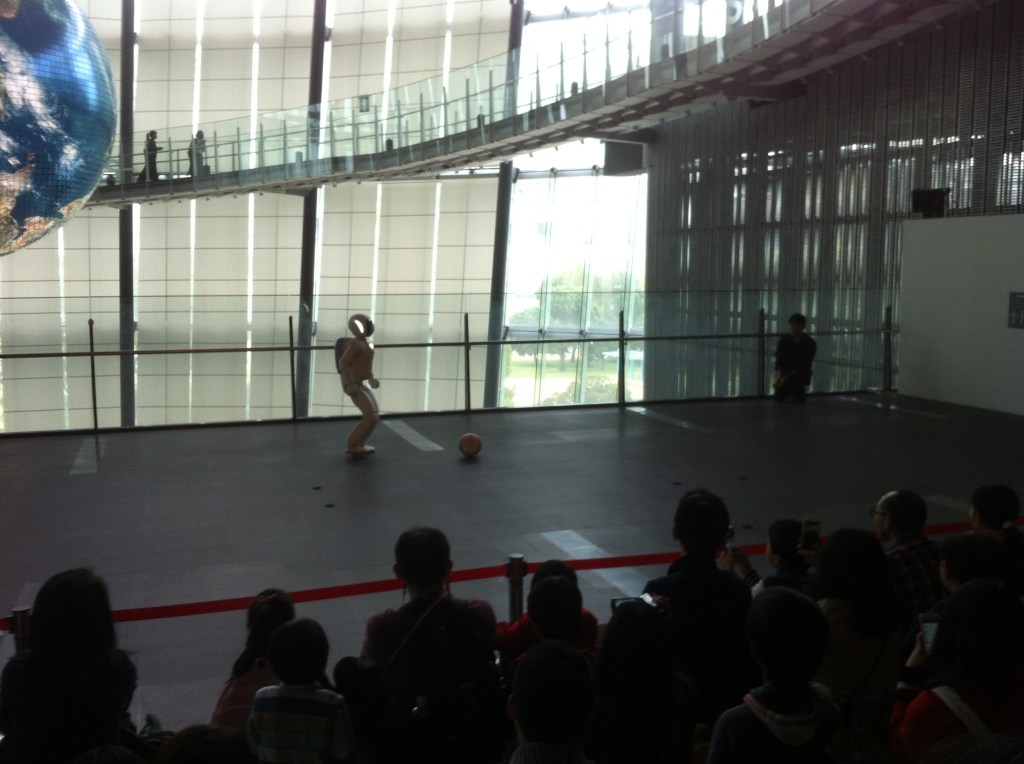
About a week later, on our last full day in Tokyo, we visited the National Museum of Emerging Science (Miraikan), where we saw ASMO, a semi-humanoid robot from Honda. Unlike the Pepper robot parked in the hotel lobby, ASMO was ambulatory, kicking a soccer ball and thus vowing the audience.
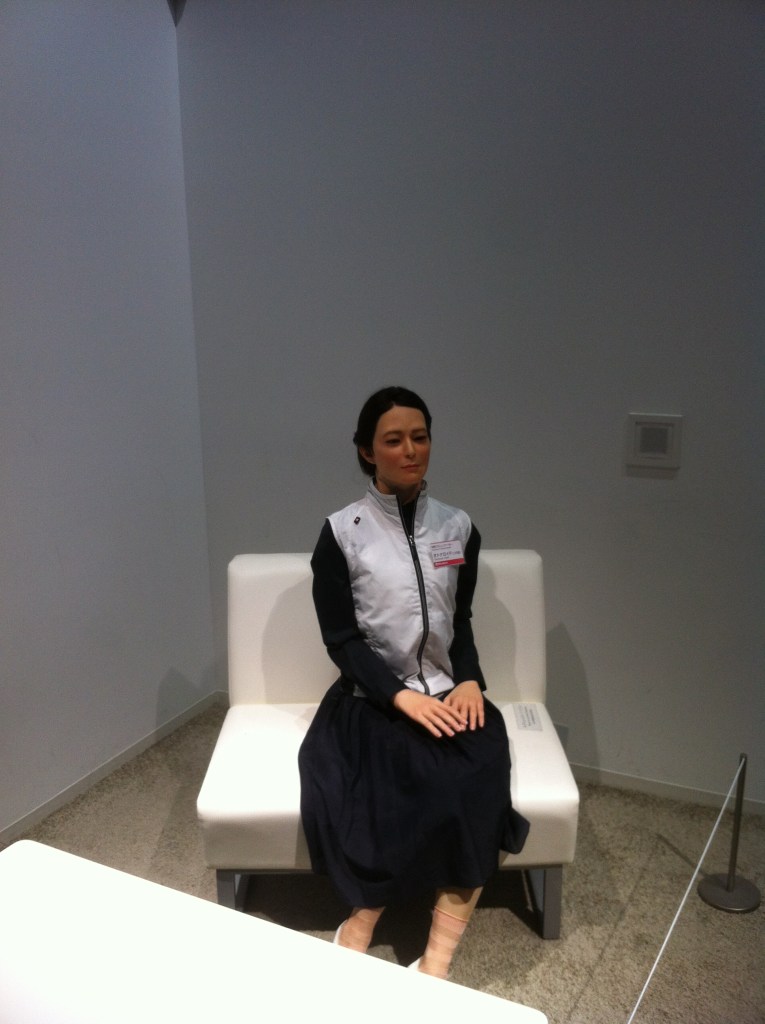
Not far from ASMO stood an android, pictured here as well, whose name escapes me. I suppose she (it?) would have similar capabilities to Alexa or Siri, but with a more compelling UI.
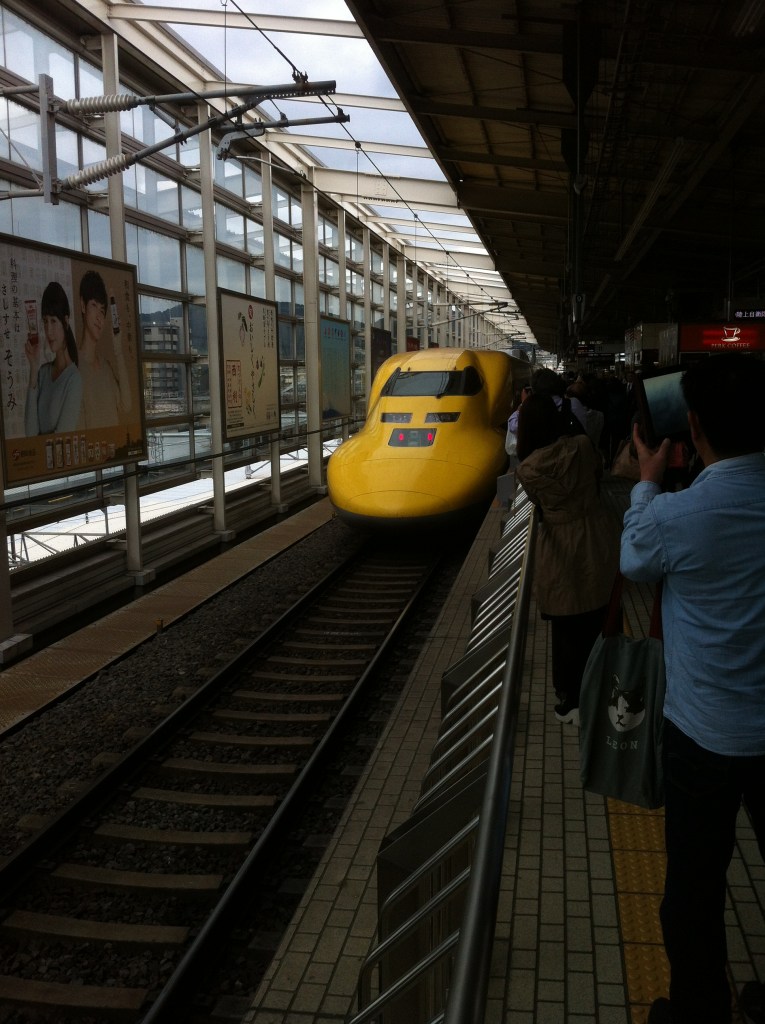
Last, but I suppose not least, at Kyoto Station we were able to see the newest (I think) model of the Shinkansen. To be sure, our Shinkansen was impressive enough, but, judging by the photo, not nearly as impressive as this bright yellow machine speeding away into the future.
In 2018, I saw Pepper’s cousin at Oakland International Airport, in front of the Pyramid Ale Taproom, informing thirsty visitors, via a mounted tablet, about the selections of the day.
Of course, five years in tech can be eons in the general economy, but, to date, Siri and Alexa are not Samantha (Her), and Will Smith’s services are not yet needed.
That said, change is afoot, but just not part of the daily experiences of most people. You will find it in modern factories and warehouses, where robots have either displaced humans or where humans now work side by side with robots, operating and maintaining them. More exotic use cases include robotic dogs with Geiger counter collars roaming the streets of Chernobyl. The pandemic has accelerated this transformation (to automation) to some extent.
The more overt, easily accessible manifestations of these somewhat recent changes are the extinction of toll collectors and the absence of cashiers at The Home Depot (although some human glue is still required to help technologically-averse shoppers with self-checkout). Returns still require human interaction. Despite the wide availability of ATMs (first introduced more than fifty years ago), people still go into banks, for more complicated transactions or perhaps to interact with another human being. Chatbots can be helpful, but if I have a less than routine request, I will still need to speak to a human representative. While I might be perfectly content riding in a robo-taxi after an early morning flight, rather than attempting a conversation with my driver without my requisite cups of morning coffee, we are not there yet, and probably at least ten years away from that reality. Put otherwise, while there may be reason for concern from a policy perspective, the change, it appears, will be gradual.
In Licensing in the Age of Artificial Intelligence (New Matter, Winter 2018), I wrote: “Yuval Noah Harari, a historian and professor, notes: “In the past machines competed with humans mainly in manual skills. Now they are beginning to compete with us in cognitive skills. And we don’t know of any third kind of skill – beyond the manual and cognitive – in which humans will always have an edge.”[i] Taking this one step further, Harari speculates, ominously, that “[b]y 2050, a new useless class might emerge, the result not only of a shortage of jobs or a lack of relevant education but also of insufficient mental stamina to continue learning new skills.”[ii] This is intentionally provocative, but it does, rightly, call into question whether or not legal education, as an example, is taking into consideration this potential (if not probable) future state and preparing students accordingly. Besides, investing more in developing a “guiding philosophy” for AI, and understanding the workings of the human mind, Harari suggests regulating the ownership of data as a means to temper the concentration of power that AI may create.
I assigned the Harari article to my students in the Technology Transactions course I taught two years ago. It was intended to be an eye opener and while the discussion was robust, perhaps it was not as robust as I had hoped. Granted, it was the first day of class, a new course, qualitatively different from others available at the law school, one of the top ones in the United States. The take-home message was as follows: there is a good chance you will forgot a lot, if perhaps not most, of what I will teach you this semester, but if you remember one thing, I hope that it is the absolute need to think critically and independently, to do your own analysis, and to determine not only if something can be done (or how it can be done), but, more importantly, should it be done.
Is it possible to future proof work? Of course, not. The skills you learn today will be useless in ten years, without practice and refinement, and even with that, the market at that point may not need those skills (or may not need them as much). Thus, learning a set of skills is necessary, but not sufficient. What is needed then is (additionally) curiosity, a commitment to lifelong learning, flexibility and stamina, for the long haul. The question then is how to instill these values at home and at school. More practical (perhaps) prescriptions include instructing every eighth grader to create a resume, in anticipation of a dream (or any) job and work backwards, thinking through the skills he or she will need to accumulate and refine for that role. More experiential learning (learn by doing) and internships would be salutary. Read the classics. Learn how to perform mental gymnastics. Find a mentor. Put down the new Mr. Beast video (or any other flavor of on-demand video offering) and go on a walk or hike and ponder. Now, during a once in a century (I hope) pandemic, is the time for it.
Needless to say, in terms of information availability and intensity, it was a much simpler world, growing up in the 1980s and going to college in the early 1990s. In the 1984 or so, my parents bought me an encyclopedia set. At my disposal as well was an almanac and perhaps the local paper (The San Francisco Chronicle), when it was still good. Additional research would require a trip to the local library, where I might find a book or two on the topic and perhaps an article or two in a physical periodical or on microfiche, after an exasperating visit to that dreadful machine. I could watch the local or national news. If I had cable, I do not remember it. Then, if I had to write about the topic, I would have to sit down, think about it, outline it, type it up on my typewriter or Apple 2c, and then submit, for further review. Simply put, if there ever was a closed, simpler universe, this was it.
Fast forward to today, where the contents of virtually every library on this planet are available on your smartphone or tablet, where we face a 25-hour news cycle, where sharing our thoughts is as easy as pressing “Post.” Navigating this is challenging at best (even for this author), which puts even greater pressure on having (and living by) core values and the need to think critically, independently, and systematically.
Thoughts welcomed.
[i] Yuval Noah Harari, Why Technology Favors Tyranny, The Atlantic, October 2018, at 66.
[ii] Id. at 67.

 The Peninsula Hiking Club