
 Art imitates life, and vice versa. Standing on one of the many terraces of Hase-dera (736) (http://www.hasedera.jp/en/), in Kamakura, a sleepy seaside town about an hour south of Tokyo, in Kanagawa Prefecture, I could not help but think of the atmospheric woodblock prints of Hokusai and imagine the confluence of meteorological events giving rise to The Great Wave Off Kanagawa (ca. 1829-32).
Usually, I can tolerate about three days in a big city before the need to escape becomes overwhelming. And, thus, on a cool, damp, Tuesday morning in late October, after three days in Tokyo, I boarded the JR Yokosuka Line at Shinagawa Station, bound for Kamakura. Zipping past Yokohoma, one of Japan’s great industrial cities and seaports, skyscrapers and sprawling apartment complexes gave way to low hills and small villages until I disembarked at Kamakura Station and, as a light rain fell, started exploring.
Travel is impossible without food, and so I found my way to a local supermarket, where I bought, among other items, a bag of Satsuma mandarins for ¥1000. I started to peel one as soon as I exited the store, only to find a Satsuma tree right behind me, with the same perfect, aromatic, not particularly acidic, and easy-to-peel fruit. Apparently, the mandarin does not fall too far from the tree.
Kamakura is known for its temples, including Kotoku-in (1252) (http://www.kotoku-in.jp), home to Daibutsu, the Great Buddha. It should not be said that once you have seen one temple (or a few), you have seen them all. At more than thirty feet tall, Daibutsu cannot but impress. The gardens are immaculate, but not as elaborate as those at Hase-dera, not more than a ten-minute walk. If you cannot find your moment of zen there, you may not find it anywhere.
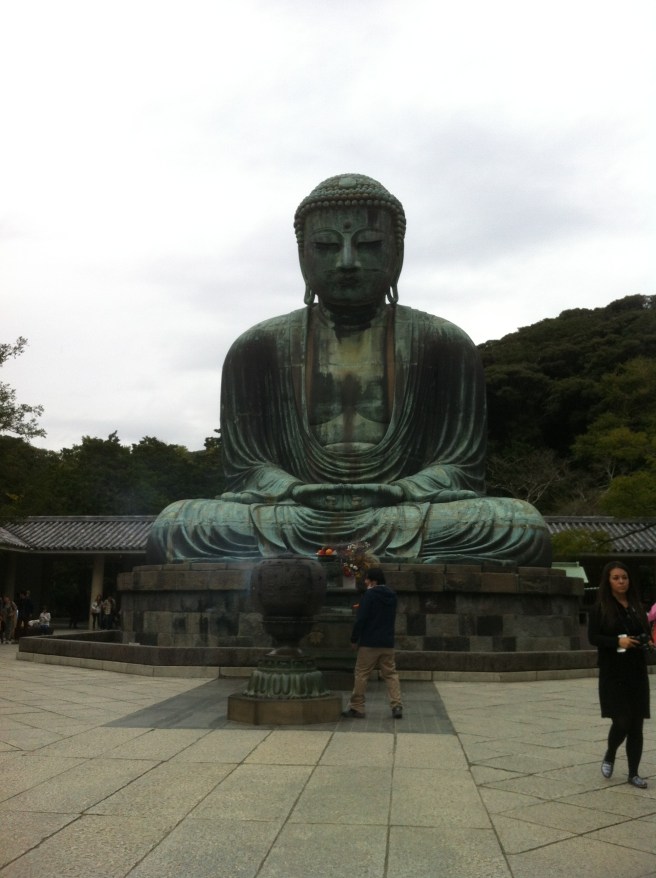 The history of Kamakura, a former seat of Japanese government (1185-1333), with the emergence of, and rule by, the Kamakura shogunate, is interesting as well, calling for, as intimated below, additional study.
As the rain increased, my pace quickened, as I traced my steps back to Kamakura Station and boarded a Tokyo-bound train replete with pensioners, school children, and other travelers, I am sure, but not before a pit stop in Yokohoma, including a walk through Nissan’s global headquarters car showroom, and a ride on Cosmo Clock 21, the world’s tallest Ferris wheel, until 1992. The past lives with the present, which, in turn, lives with the future. Balancing all three is a form of art, one that Japan, to a foreigner’s eye, seems to do well.
While I was fortunate to explore Kamakura from various angles, the exploration was intentionally superficial. There was a lot to see, generally, and I did not have the time. For example, I could have researched Kamakura’s history in advance and then focused my visit on a particular temple, perhaps Kotoku-in, for a more enriching visit. With anything, there are opportunity costs.
Comments welcomed.

 The Peninsula Hiking Club