
 Not a day goes by that I am not reminded of Tokyo. Let me explain.
The Pilot Juice Up 0.3mm retractable gel pen is surgical. I purchased two, and replacement ink, from a store in the Odaiba Mall facing Tokyo Bay. At only ¥200, I should have bought more.
This Juice Up (other versions exists) has become my favorite, seeing daily use in my journal and on legal pads and countless documents. While variety, I have been told, is the spice of life, my other pens, including ones from Cross, Mont Blanc, and Waterman, are rarely used, eclipsed, and rendered almost irrelevant, by the Juice Up 0.3.
Tokyo is known for its many, and in some cases, over-the-top stationery stores. One of the most famous is G. Iotya, in Ginza, affording visitors eight stories of stationery delight. I carefully explored each floor, testing a variety of pens and mechanical pencils and sampling an equally varied assortment of paper. While I am almost certain that G. Itoya carried the Juice Up 0.3, it was still early days, and it seemed that I could do better than a pen as a souvenir for a trip that I had been planning for years.
While the Japan bug most likely bit after watching Lost in Translation (2003), it is quite possible that the seed was planted many years before, growing up in San Francisco, visiting the Japanese Tea Garden, in Golden Gate Park, and traversing its famous Drum Bridge, built in Japan and shipped to the City by the Bay for the 1894 World’s Fair. Childhood visits to Japantown, and in particular, to the courtyard housing the 5-tiered peace pagoda, added to the mystery. Walking on the cold sands of Ocean Beach, I could not help but wonder about life on the other side of the Pacific, and, especially Japan, with its juxtaposition of old and new, perfectly planned (and manicured) gardens, rituals, and customs.
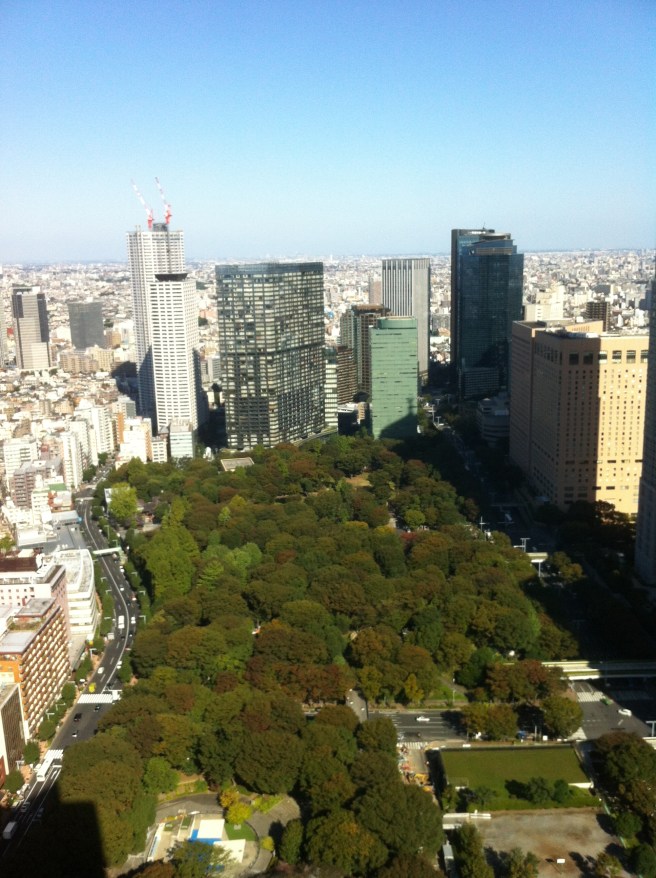
Pictured above is the view from the lobby of the Park Hyatt Tokyo, forty floors above Shinjuku Chuo Park. I had known that Lost in Translation had been filmed at the Park Hyatt, and it helped that our first home in Tokyo was five minutes away, at the Hyatt Regency. I could imagine Bob Harris at the lobby bar, listening to the dulcet tones of the local jazz band or asking Charlotte to join him in breaking out of the hotel (and middle age ennui).
I expected Tokyo to be disorienting, but not uncomfortably so. To prepare, I read books, researched itineraries, and consulted with family and friends who had visited or lived in Tokyo. Based on business dealings with Japanese counterparties, I expected politeness, some level of conservatism, precision, and attention to detail. Tokyo did not disappoint.
People were helpful, and despite my very limited Japanese (arigato), but with capable assistance from Google Maps, we were able to get around without any real difficulty. The JR line allows a visitor to circumnavigate Tokyo with ease. Add to this a world-class metro and the fact that Tokyo is one of the great walking cities in the world, and you can see that the stage is set is for adventures and surprises.
Start with sashimi breakfast at Tsukiji Fish Market, explore the many fine shops in Ginza (including, of course, G. Itoya), visit Tokyo Station and its prodigious food court, enjoy a moment of zen at Zojoji Temple (1598) at the foot of Tokyo Tower (1953), ride the elevator the top and take in 360 degree views of the Tokyo skyline, and continue to (and up and down the hills of) Roppongi, for dinner and then a quick metro ride to your hotel (if not within walking distance). Or, explore the calming, maze-like secret streets behind Takeshita Street (chaos) in Harajuku, before concluding your walk at Shibuya Crossing (managed chaos), arguably the busiest intersection in the world. I could go on, and as you can imagine, it is impossible but to scratch the surface during a one-week visit to a city as vast, complex, and interconnected as Tokyo.

I found ceremony in unlikely places. It is customary, apparently, for change, after a purchase, to be put on a tray, which, in turn, is given to the purchaser. While perhaps reading too much into this, this discrete act suggested to me an appreciation for the customer or, if not that, at least a connection between customer and vendor and an appreciation for carefully considering and ultimately selecting an item from a vendor.
Tipping, if not prohibited, was certainly, in my experience, frowned upon, suggesting, among other things, a more robust social safety net. While I am no expert in reading social cues in foreign lands, people seemed reasonably content with their jobs, focusing on performing the tasks at hand, and while I am sure there existed no shortage of social climbers, I did not get the sense, like in some places, that a given job was only a stepping stone to something better and brighter. Likewise, I did not get the impression, like I do back home, that there were many other places a worker would rather be. Still, with an ageing population (and a shrinking population of workers) and the issue of karoshi (overwork), all is not rosy.
On my last day in Tokyo, a damp, sleepy Sunday in late October, I found myself in a Starbucks in Tennozu, near Shinagawa Station, on the bottom floor of one of the many office buildings in the area. I ordered my usual coffee and muffin or scone and scanned the store to see what folks were up to on this Sunday morning. At the next table, a woman was writing in her journal, with a very fine point (perhaps 0.3mm) pen, possibly planning her week or reflecting on the one that just passed. Strangely, this, to me, was the essence of Tokyo, the focus on the discrete, the compartmentalized, the here and now, amid the skyscrapers of big ideas, pressing needs, and general obligations.
Comments welcomed.

 The Peninsula Hiking Club